


Every technical SEO has a version of this meeting.
The migration shipped on Friday. The redirects went in. Someone on Monday noticed organic traffic had fallen off a cliff, and someone else remembered there was, in fact, an SEO on the team somewhere, and perhaps they should take a look.
This isn’t the meeting anyone puts on the LinkedIn headline. It’s the forensic cleanup. The polite explanation of why a decision you weren’t consulted on is now producing consequences you would have flagged if anyone had thought to tell you it was happening. The quiet realisation that your job, not for the first time, is to do archaeology on an outcome that was predictable the moment the roadmap got drafted without you in the room.
Welcome to SEO. The dark art. The mysterious discipline. The thing executives describe in tones usually reserved for alternative medicine and aggressive tax planning, and the profession The Verge once called “the people who ruined the internet.”
The industry has spent years worrying about this reputation. There are conference talks. There are working groups. There are, I assume, strategic initiatives. The prescribed fix never changes: SEOs need to communicate better. Get a seat at the table. Build executive presence. Translate technical concepts into business value. Develop soft skills. Take an MBA. Learn storytelling. The recommendations multiply every year, nobody moves, and everyone agrees there’s a problem.
Here is the part nobody at the working group seems willing to say: The reputation is earned. Not because SEO is actually mystical. It isn’t. The reputation is earned because the profession has been filed under marketing for twenty years, and a discipline responsible for outcomes it has no authority to produce behaves, from the outside, exactly like dark magic.
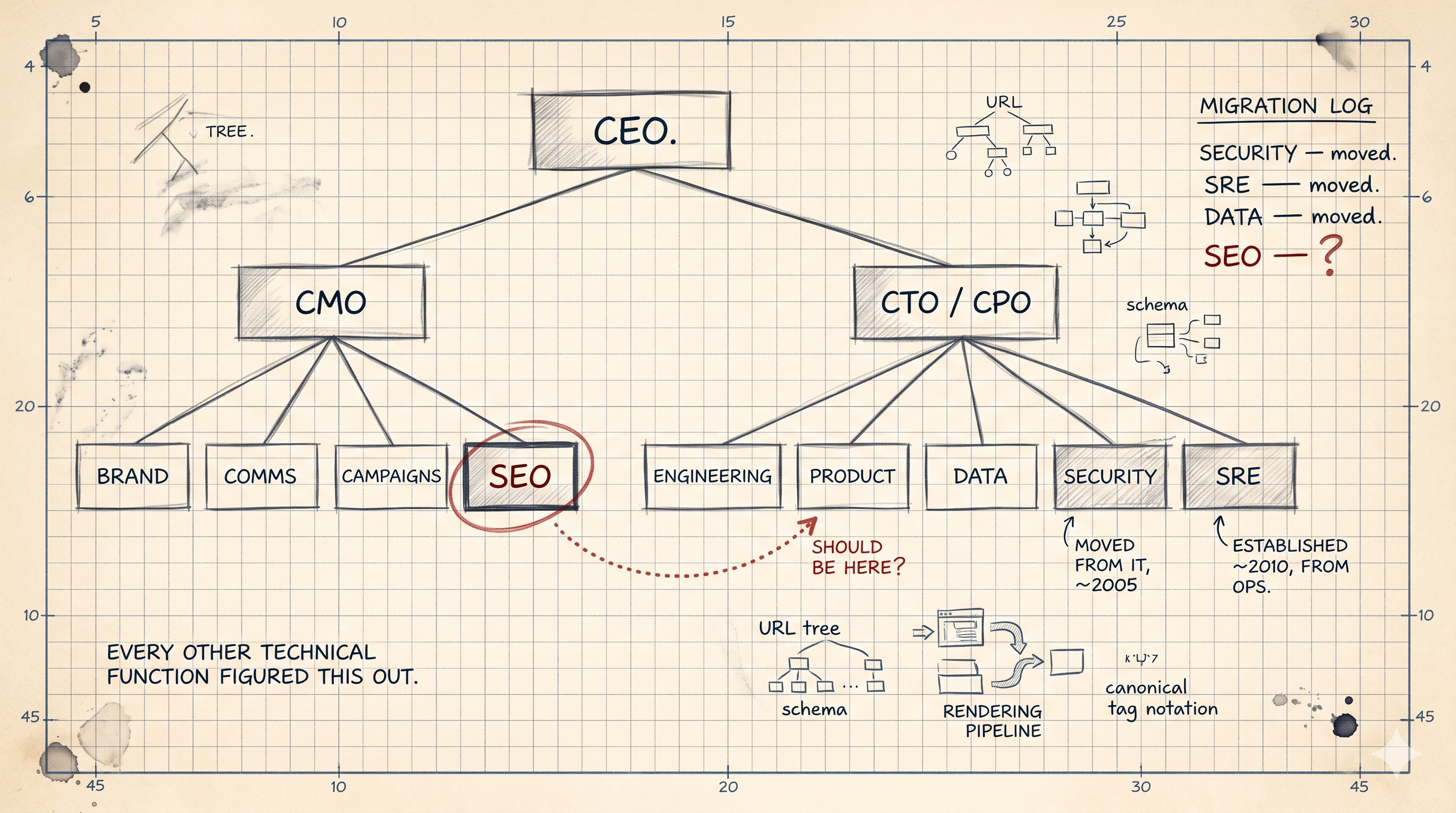
SEO is in the wrong part of the org chart. Everything called a perception problem flows from that one structural mistake. The rest of this post is what the mistake has produced, why it’s about to get materially worse, and why the people with the authority to fix it aren’t going to.
Responsibility without authority
Here’s the list of things SEO is expected to produce outcomes on.
URL structure. Rendering behaviour. Canonical signals. Internal linking architecture. Schema and structured data. Content modelling. Information architecture. Pagination. Faceted navigation. Crawl efficiency. Indexability logic. Status codes. Redirect chains. Site performance. Mobile parity. Image and media handling. Hreflang. The sitemaps. The robots directives. The rendering pipeline that decides whether any of the above reaches a crawler in the first place.
Here’s the list of those things marketing owns.
None of them.
Every item on the list is owned by product or engineering. Some of them are owned so deep inside engineering that getting them changed requires a ticket, a sprint, a roadmap slot, and a PM willing to argue for prioritising work they don’t personally benefit from shipping. That’s fine if you’re inside the org that owns the thing. It’s a problem if you’re a marketing function being asked to influence it.
This is the diagnosis. It has a name in every discipline that’s had to deal with it: responsibility without authority. Someone is accountable for an outcome they can’t unilaterally produce. It’s a known failure mode in organisational design, which is a polite way of saying every other discipline figured this out decades ago. In SEO, we’ve normalised it so thoroughly that practitioners build whole careers around being good at it.
The skill the industry calls “stakeholder management” is the skill of working around this problem. Translate. Influence. Build relationships. Earn trust. Tell the story. Take the executive to lunch. All of it is the language of a function that has to beg for every deliverable, because it can’t ship any of them itself.
Let’s be clear about what begging produces. When SEO needs a canonical fix, it asks engineering. When it needs a URL structure change, it asks engineering. When it needs schema implemented, it asks engineering. When it needs pagination logic redesigned, it asks engineering. When it needs the rendering pipeline adjusted so that the content actually reaches crawlers, it asks engineering very politely, ideally with a deck. None of those requests are guaranteed to be honoured. The function making the request doesn’t own the backlog, doesn’t set priorities, and doesn’t report into a leadership chain that can force the issue.
What does the function own? Content. Specifically, the content it can produce without asking anyone. That’s the one lever it can pull cleanly. We’ll come back to what that does to the profession’s theory of the world.
The genuinely embarrassing part is that everyone involved agrees the arrangement is dysfunctional. Marketing leaders complain that SEO can’t deliver. SEOs complain that they have no authority. Engineering complains that SEO requests arrive late and without context. Product complains that nobody told them. Everyone’s right. They’re all looking at the same structural error from different sides of it.
The fix isn’t better stakeholder management. The fix is moving the function to the part of the org that owns the surface area it’s responsible for. Not a title change. Not a dotted line. Not a cross-functional working group that meets on Thursdays. Actual reporting into the org that owns the work, with the authority, budget, and priority access that comes with it.
This isn’t a radical proposal. Every other technical function figured it out decades ago. Security used to be treated as a side concern of IT, was consistently marginalised, and now lives under its own leadership because the failure mode was too expensive to ignore. Site Reliability Engineering was invented specifically because treating reliability as someone’s part-time concern produced predictable outages at scale. Both disciplines moved when it became clear the work couldn’t be done from where it had been filed.
SEO is the last major technical discipline still filed under the function that doesn’t own any of the work.
Campaign time vs. infrastructure time
Marketing operates on campaign time. Quarterly planning. Monthly reporting. Weekly standups where someone asks what moved since last week. It’s a rhythm optimised for activity you can start, finish, and measure inside a budget cycle. That rhythm is load-bearing for a lot of what marketing actually does. Campaigns have start dates and end dates. Launches have moments. Brand work compounds, but most of the artefacts a CMO is evaluated on are discrete, time-boxed, and attributable to a quarter.
SEO doesn’t operate on campaign time. It operates on infrastructure time.
The work that produces durable search presence is the work of getting architectural decisions right and then leaving them alone for years. A URL structure that survives three migrations is worth more than a content campaign that trends for a week. An information architecture that scales with the business is worth more than any individual piece of content that lives inside it. The compounding is in the foundations, not the surface. Practitioners know this. It’s in every conference talk about technical debt, every post-mortem on a botched migration, every hushed conversation about a client who redesigned their site without telling anyone.
Try explaining infrastructure time to a function measured on quarterly pipeline contribution.
The function can’t hear it. Not because the people in it are stupid. They aren’t. It can’t hear it because the evaluation framework can’t process it. A CMO who invests this quarter’s budget in work that won’t produce visible returns for eighteen months is a CMO who won’t be at the company in eighteen months to see the returns. The incentive structure of the role forecloses the investment. You can’t ask someone to spend their political capital on outcomes that will land after they’ve been replaced. They will, rationally, spend it on outcomes that land before the next board review.
So the work gets compressed. The infrastructure conversation becomes a content conversation, because content can be produced inside a quarter. The migration becomes a launch, because launches have dates. The site architecture becomes a “content strategy refresh,” because that’s the vocabulary the budget line expects. Every part of SEO that doesn’t fit inside the campaign calendar either gets deprioritised, rebranded as something that does fit, or quietly declared out of scope.
This is why SEO audits sit on shelves. The audit correctly identifies forty-seven architectural issues that will take eighteen months of engineering time to resolve. The function responsible for acting on the audit has to report results next quarter. The maths doesn’t work. The audit gets filed, the function ships a content campaign, and the forty-seven issues stay on the shelf until the next agency writes the next audit identifying the same forty-seven issues, phrased slightly differently. Sometimes the new agency charges more for identifying them a second time. It’s a growth industry.
You can spot a site that’s been through this cycle a few times. It has a lot of content. It has very little that works.
The point isn’t that campaign time is wrong. It’s that campaign time and infrastructure time are different timescales, and you can’t get infrastructure outcomes by running infrastructure work on a campaign cadence. It’s the operational equivalent of asking someone to build a foundation during a sprint. You’ll get something poured, and it will not hold.
Product orgs already understand this. Roadmaps are measured in quarters but planned in years. Architectural decisions get scoped against multi-year consequences as a matter of routine. The entire discipline of engineering management exists to reconcile the short-term delivery pressure with the long-term integrity of the system. It’s not perfect. Product orgs have their own pathologies, and anyone who’s watched a feature factory run itself into the ground can list them. But the conceptual vocabulary for treating some work as infrastructural is there. The meetings exist. The rituals exist. The career paths exist for people whose job is to protect long-horizon work from short-horizon pressure.
None of that vocabulary exists in marketing. It was never supposed to. Marketing’s job isn’t infrastructure. That’s the point. Putting SEO in marketing isn’t just a filing error. It’s filing infrastructure work inside the one function in the org explicitly structured not to do infrastructure work.
When content is your only lever
Here is the thing about being trapped in responsibility without authority on campaign time: it shapes what you believe.
A function can only develop expertise in the problems it’s allowed to solve. When the only lever a profession can pull without asking permission is content, the profession slowly, over years, over careers, over decades, develops a theory of the world in which content is the answer to most problems. Not because anyone sat down and decided that. Because the feedback loops that produce professional instincts only have one surface to operate on.
You ship content. You measure content. You get promoted for content. You train juniors on content. You write conference talks about content. You consult on content. Eventually you believe, in the genuine, felt-in-your-bones way that professional instinct works, that content is what SEO is. Not because you’ve reasoned your way there. Because it’s the only thing the structure around you has ever let you ship.
Google hasn’t exactly helped. For twenty years, the headline advice out of Mountain View has been “create great content.” Never “build a valuable product.” Never “get your architecture right.” Never “think about whether the thing you’re publishing should exist.” The technical guidance is in the docs, buried where most of the profession doesn’t read, written for engineers who aren’t the ones being asked to act on it. The loud advice, the one that became the industry’s shared vocabulary, the one repeated in every Search Central video and quoted in every agency pitch, was always about content. Practitioners followed the loudest signal available. That’s what professionals do. The signal pointed at content for two decades, and the profession dutifully pointed itself in the same direction.


None of this absolves the industry. It does explain why the dysfunction has been so stable for so long. When the structure you work inside can only fund content, and the authority figure you’re trying to please only talks about content, developing a non-content theory of the work requires actively ignoring two reinforcing signals at once. Most people don’t. Most people shouldn’t have to.
This is how the industry ends up with GEO positioned as “optimise your content for LLMs”. It’s how “E-E-A-T” got absorbed as a content-quality checklist rather than what it actually describes. It’s how every major architectural shift in search and retrieval over the last five years has been immediately translated into a content prescription, regardless of whether the underlying change had anything to do with content.
AI Overviews arrive. The industry response: write content that gets cited.
RAG pipelines become load-bearing for half the AI assistants on the internet. The industry response: write content that chunks well.
Agent browsers start navigating sites on behalf of users. The industry response, presumably arriving next quarter: write content for agents.
None of these responses are wrong, exactly. Content does play a role. The response is incomplete in a consistent, predictable direction, and the direction is the direction of the only tool the profession has ever been allowed to use. When all you have is a content calendar, everything looks like a content gap.
The architectural work that actually governs whether any of this succeeds (rendering pipelines, data models, URL design, schema, crawl surfaces, API exposure, the question of whether your application even produces stable, parseable HTML for a non-human client) sits outside the function making the prescription. So the prescription routes around it. It has to. The function doesn’t have the authority to ship the architectural work, so the architectural work exits the recommendation.
What the client receives is a content strategy. What the client needed was an architecture review. The consultant isn’t being dishonest. They’re producing the output their seat in the org allows them to produce.
This is the dysfunction loop. Marketing placement produces a content-only toolkit. The content-only toolkit produces a content-only theory of the work. The content-only theory produces prescriptions that ignore architecture. Sites spend a decade following those prescriptions. The architectural debt compounds. Eventually something important breaks, a migration, a rendering change, a platform shift, and someone wonders why all that content didn’t save them.
It couldn’t have. The content was never the load-bearing layer. The industry just lost the vocabulary to describe what was.
Four retrieval contexts, one architecture problem
For most of SEO’s existence, there was one retrieval system that mattered. Googlebot crawled, Google’s index stored, Google’s ranking algorithms ordered, and whatever Google shipped defined the work. The profession developed against a single target. That target’s requirements were stable enough, for long enough, that “SEO” and “Google SEO” became synonymous to the point where nobody noticed the conflation.
That era is over. The target has multiplied, and the new targets don’t share requirements.
My read is that most sites now need to be correctly interpreted by not one retrieval system but at least four, each with materially different architectural needs. Classic search crawlers still do what they’ve always done, fetch, render, index, rank, and still care about rendered HTML, canonical signals, internal linking, and crawl efficiency. That work hasn’t disappeared. It’s just no longer the only work.
Alongside it sit three classes of retrieval that have arrived, are arriving, or are about to arrive at scale. Retrieval-augmented generation pipelines, where content gets chunked, embedded, and surfaced in response to queries that may never touch a traditional search results page. Agent browsers, where software acts on behalf of a user, filling forms, completing purchases, extracting information, and needs the site’s interactive surface to be stable, parseable, and actionable. Training crawlers, whose presence on your site determines whether your content is even available to the models that power everything upstream of it.
Each of these has different requirements, or at least that’s what the behaviour I’ve seen suggests. RAG pipelines appear to reward content that survives chunking: semantic boundaries that align with how retrieval windows get constructed, prose dense enough to carry meaning when it’s separated from its surroundings, metadata that persists through tokenisation. Agent browsers appear to reward interactive affordances that hold up to automation: stable selectors, predictable navigation, structured data that describes what can be done on a page and not just what it says. Classic crawlers reward what they’ve always rewarded, and the requirements occasionally conflict with the others. Content optimised for chunking may render poorly when the crawler expects traditional page structure, and sites that expose rich agent-friendly surfaces may produce indexing decisions that weren’t obvious a year ago.
I’d stake the general shape of this on the table: multiple retrieval contexts with overlapping but non-identical requirements. The specifics will keep moving.
None of this is a content problem. All of it is an architecture problem.
Deciding how your site serves four classes of non-human client with partially conflicting requirements is a product decision. It touches the rendering pipeline, the data model, the API surface, the URL structure, the caching strategy, the authentication boundaries, the robots directives. It requires trade-offs that can only be made by someone with the authority to ship across engineering and content at the same time. It requires someone to look at the four retrieval contexts, understand which ones matter for this specific business, and accept that you probably can’t optimise for all of them simultaneously.
That person is not in the marketing meeting. That person is in the architecture meeting, which is a meeting SEO generally isn’t invited to.
So what’s happening instead is predictable and, at this point, depressing to watch. The industry is translating each new retrieval context into a content prescription, because that’s the translation its org chart permits. RAG arrives and the advice is “structure your content for retrieval.” Agent browsers arrive and the advice will be, within a quarter or two, “write content agents can parse.” The architectural half of the work, the half that determines whether any of the content prescriptions can even be executed at the infrastructure level, goes unsaid, because the people producing the advice don’t have authority over it.
Meanwhile the product teams making the actual architectural decisions aren’t making them with any of this in mind. They’re not malicious. They’re not negligent. They’re just not briefed, because the function that should be briefing them is in a different part of the org, producing a content strategy instead.
This is how sites go dark. Not in a single dramatic event. In a compounding sequence of architectural decisions, each individually defensible, made without anyone in the room whose job is to notice what happens at the retrieval layer when you ship them all together. The site doesn’t disappear. Its presence across four retrieval systems gets quietly, progressively worse, and by the time it shows up in a dashboard it’s already eighteen months of decisions too late to fix cleanly.
The function that could have prevented this was downstairs, writing a blog post about E-E-A-T.
Decisions in rooms SEO isn’t in
Ask any technical SEO with a decade of scar tissue to describe the worst projects of their career. You’ll get a specific kind of story.
Someone decided to migrate the CMS. Someone decided to rebuild the frontend in a framework that rendered client-side by default. Someone decided a new URL structure was cleaner. Someone decided the old blog wasn’t worth porting. Someone decided the redirect logic could be simplified. Someone decided canonical tags were “technical debt.” Someone decided that consolidating three subdomains into one would be straightforward. Someone decided product pages didn’t need structured data because the new design handled it visually.
The word “someone” is doing a lot of work in those sentences. The someone is never an SEO. The SEO arrives after the decision has shipped, gets asked to “help with the SEO implications,” and spends the next six to eighteen months producing a recovery plan for a catastrophe that was entirely predictable at the point the decision got made.
This is not an accident of scheduling. It’s a structural consequence of where the function sits. Architectural decisions get made in meetings that belong to product and engineering. Those meetings have invite lists. The invite lists reflect who owns the work and who has the authority to block it. SEO, filed under marketing, is on neither list. Sometimes a senior SEO in a mature org has cultivated enough relationships to hear about decisions informally, early enough to influence them. That’s an individual achievement won in spite of the structure, not a property of the structure itself. The default state, the thing that happens when nobody has engineered around the problem, is that the architectural decisions get made and SEO finds out afterwards.
“Get SEO a seat at the table” is the industry’s perennial rallying cry for this problem. Twenty years of conference talks have urged practitioners to be more strategic, more influential, more business-aligned, more whatever it takes to get invited to the meeting. It hasn’t worked. It can’t work. The meeting isn’t a table you get invited to. It’s a meeting for the org that owns the system being decided on. You’re either in that org or you’re not, and no amount of storytelling improves the address on your org chart.
The practitioners who have, genuinely, managed to get into the room did it the hard way. They built enough credibility with product and engineering leadership that they became de facto members of decisions they had no de jure claim on. That’s a real achievement. It’s also not reproducible at scale. A profession can’t be built on the assumption that every practitioner will, through force of personality and political skill, overcome the structural arrangement of the function. Most won’t. Most shouldn’t have to.
The fix is to change the arrangement, not to keep demanding that individual practitioners heroically overcome it.
The field isn’t what it looks like from the outside
There’s a second-order problem here that the “move SEO to product” argument has to confront honestly. Even if the org chart changed tomorrow, the supply of practitioners who could do the work the new placement demands is thinner than the industry is willing to admit.
SEO has the lowest barrier to entry of any technical discipline in the digital field. No certification actually means anything. No degree is required. No apprenticeship is standardised. People arrive from copywriting, from PPC, from affiliate marketing, from blogging, from whatever adjacent role they were doing when someone at a meeting said “we should probably do some SEO” and they were the nearest person available. The field absorbed all of them. Then it labelled them all “SEOs” and treated the label as if it meant something consistent.
It doesn’t. Two people with “Senior Technical SEO” on their LinkedIn can have knowledge bases that barely overlap. One of them spent ten years running log file analyses and arguing with engineers about rendering pipelines. The other spent ten years optimising meta descriptions and building internal linking strategies in a CMS. Both are senior. Both are technical. The word means different things to each of them, and the industry has never insisted it should mean anything in particular.
For a long time this didn’t matter much, because the bar the field had to clear was low enough that the distribution of capability still produced acceptable outcomes on average. Sites got published. Content got indexed. Rankings happened. The weaker end of the distribution didn’t cause obvious catastrophes because the systems being optimised for were forgiving. Google was doing most of the heavy lifting and the profession could ride on top of that.
The bar has moved. The work the piece has been describing (making architectural trade-offs across four retrieval contexts, sitting in product meetings with the authority to influence infrastructure, understanding what happens at the retrieval layer when engineering ships the quarterly roadmap) requires a specific profile. Deep technical literacy. Fluency in how web systems actually work, not just how they’re supposed to work. The capacity to read a rendering pipeline and know what it’s going to do to indexability. The capacity to sit in a conversation about caching strategy and understand which decisions will quietly delete the site from retrieval systems that don’t forgive as much as Google did.
That profile exists. It’s a minority of the field. It’s been a minority of the field for a long time, because the structure of the profession has been selecting against it. When the work that gets funded is content, the people who get promoted, hired, trained, and retained are the ones good at content. Twenty years of that selection pressure produces exactly the distribution you’d expect. The profile the industry needs most for the work emerging now is the profile the industry has been filtering out for a generation.
This isn’t a character judgement on individual practitioners. It’s an observation about what happens when a field has no barrier to entry, no standard of practice, and a structural incentive pointing everyone in the same narrow direction. You get a very large population, labelled uniformly, with wildly uneven actual capability, over-indexed on the parts of the work the structure rewards.
And the industry’s own self-descriptions make this worse. Every agency pitches “full-service SEO” as if it were one thing. Every job description asks for the same generic list of responsibilities. Every conference talk is titled as if it’s addressed to a profession with a shared baseline. None of that is true. The field is a patchwork, and the patches don’t know how different they are from each other until one of them is asked to do work the other couldn’t.
The matching failure
So there’s a rare profile, scattered across a field that doesn’t know it’s rare. There are organisations that urgently need it, without knowing what it looks like. And there’s a labour market connecting them that’s been trained to produce and consume the wrong match.
Practitioners who could do the product-driven work often don’t know they could. They’ve spent their careers inside marketing org charts, performing the work marketing funded, being evaluated against marketing metrics. Nothing in their day-to-day has ever mirrored back to them that their actual capability is architectural. They think they’re marketers who happen to be good with technical detail, because that’s the only identity the structure around them has offered. Some of them would be transformative hires in a product org. They’re not applying, because “senior SEO” job listings aren’t framed in a way that tells them they should.
Hirers are worse off still. An organisation that genuinely needs a product-embedded technical SEO, someone who can sit in architecture reviews, argue retrieval trade-offs with engineering leads, and prevent the next migration from quietly removing half the site from indexing, will write a job description that asks for none of those things. Not out of malice. Out of not knowing. The hiring manager copies the last SEO job description the company used, which was written by a marketing director who copied one from their previous employer, which was copied from an agency template, which was a descendant of a 2015 list of generic SEO responsibilities. The job listing asks for keyword research, content strategy, and “familiarity with technical SEO best practices.”
Then, having asked for the wrong things, they evaluate candidates against the wrong instrument.
The CV gets scanned for tools. Ahrefs. Semrush. Screaming Frog. Sistrix. Botify. DeepCrawl. Ahrefs again, because it was listed in a different section. The logic, such as it is, is that knowing the tools means knowing the work. It doesn’t. Tool proficiency is the thing you pick up on the first day of a new job. It’s genuinely the least interesting information on an SEO’s CV, and HR treats it as the most. A candidate who can name twelve SEO suites gets prioritised over a candidate who can explain why the rendering pipeline is quietly deindexing a third of the site, because the first CV is legible to the evaluation framework and the second isn’t. The second candidate probably also knows the tools. They just didn’t think listing them was the point. They were wrong about what the point was. Not in reality, but in the system they were applying through.
The person the company actually needs reads the job listing, doesn’t recognise themselves in it, and doesn’t apply. The person who does recognise themselves in it applies, lists fourteen tools, and gets hired. The organisation believes it has conducted a search. What it has conducted is a filter, and the filter was calibrated to exclude exactly the person it was supposed to find.
The market can’t execute the match even when both sides of it exist. The vocabulary that would let them find each other was never produced, because the function that should have produced it has been too busy defending its own legitimacy inside marketing to define what it actually is.
Meanwhile HR departments, who are not the villains of this story but who can only hire against the descriptions given to them, run searches optimised for the profile the field has always produced. They find candidates. The candidates are hired. The hires are placed in marketing, where the next cycle of the same pattern begins. The people who could have broken the loop are somewhere else, unreachable through the channels the organisation knows how to use.
This is the deepest layer of the dysfunction. Placement produced the wrong selection pressure. The selection pressure produced a skewed professional population. The skewed population produced self-descriptions that encoded the placement. The self-descriptions produced hiring frameworks that reproduced the placement. Every turn of the loop made the next turn more certain. Nobody designed this. It’s just what happens when a structural error is allowed to run for twenty years without anyone senior enough to fix it noticing that it was the structure, not the people, that needed fixing.
The room stays the same
This isn’t a respect problem. Respect doesn’t move the role. The profession could earn the respect of every CMO on earth by next Tuesday and the work would still be happening in the wrong room, because the work was never a marketing problem to begin with.
The decisions that determine whether a site exists to search engines, RAG pipelines, agent browsers, and training crawlers are product decisions. They always were. We’ve just been staffing them with marketing hires and acting surprised when marketing instincts produce marketing outputs.
The people who could make those decisions at the level the work now requires do exist. There aren’t many, because the field has spent twenty years selecting for a different profile. There will be fewer of them in five years, because the pipeline that produced them is being automated away. And the organisations that most need them won’t find them, because the job descriptions are being written by someone who read exactly one SEO blog, in 2019.
For what it’s worth, I’ve been working this way under the banner of SEO Product Management since before the term had traction. I didn’t invent the model. I just refused to pretend the marketing placement was working.
So the industry does what it always does when it can’t change the room: it changes the vocabulary. GEO. AEO. Whatever the next Sand Hill Road newsletter proposes. None of it gets anyone into the meeting. It just makes the exclusion sound current.
The dark art reputation is going to stay intact a while longer. It’s an impressive illusion: making a product function look mystical by never letting it into the room where the decisions get made. Magicians have been running versions of this trick for centuries. It works best when the audience doesn’t know what they’re not seeing.
This is a problem that we have seen in italy too, for years ! Since we publish a weekly video on youtube for our italian audience, would it be a problem if we cite your article ?